

Motorised Pergola vs Retractable Awning: Which Is Right for Your Patio?
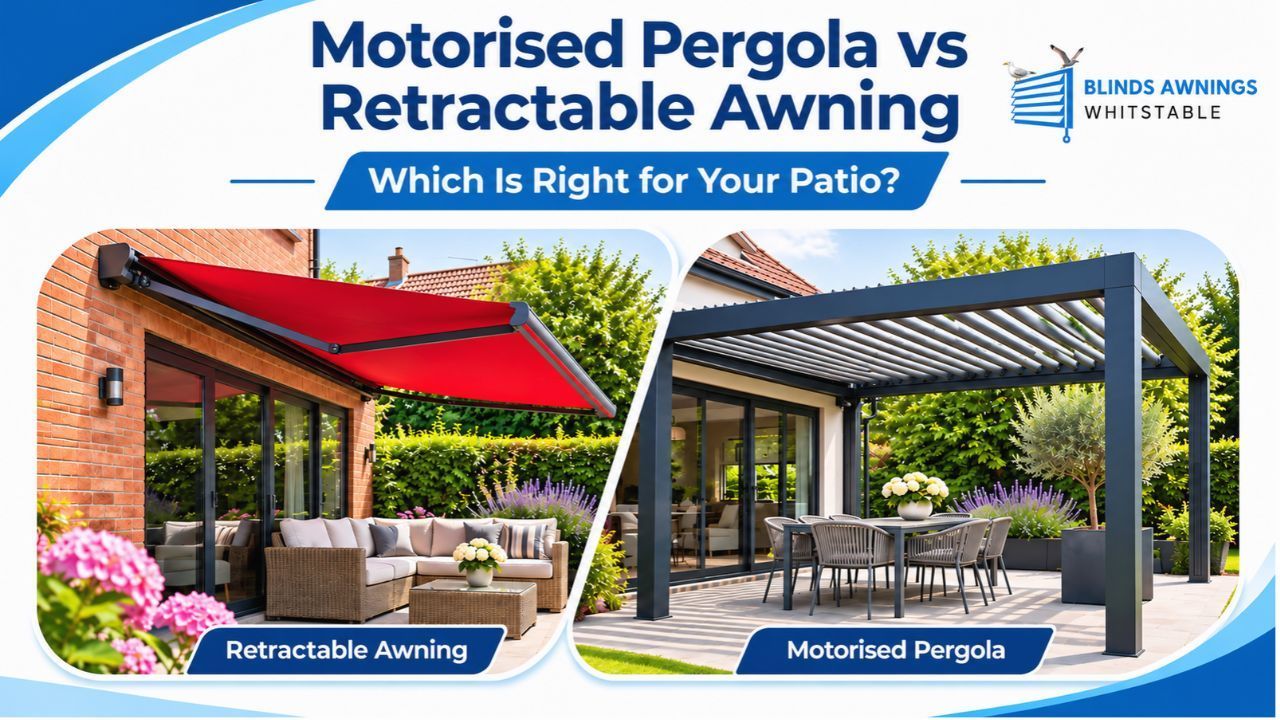
Choosing between a motorised pergola and a retractable awning isn't simple. It's not only about price; it also depends on your house, patio, and garden. Another important deciding factor is how you plan to use the space.
A motorised pergola and a retractable awning have one thing in common. Both give you covered seating at the push of a button, but in different ways. When making a decision, you should consider:
● How much weather they handle
● How they are fixed
● How much of your patio they can cover
● What they cost.
In this guide, we’ll go over each difference in simple terms. Now you can compare quotes with confidence and make an informed decision.
Motorised Pergola vs Retractable Awning: A Quick Look
A
retractable awning is a fabric roof supported by metal folding arms. It's fixed to your house wall. As the name suggests, a retractable awning can extend when you want cover and fold over the patio when you want open sky.
On the other hand, a motorised pergola is a frame with a roof that opens and closes. It comes in fabric or in aluminium louvre variants. Unlike an awning, it can stand on its own or lean against the house.
Quick Answer
For homeowners looking for shade on a wall-side patio, a retractable awning is the best choice. This is for two reasons:
For smaller outdoor spaces, a
retractable awning for a balcony can also provide convenient shade without taking up valuable floor space.
● It costs less
● It requires less construction work
Choosing a motorised pergola makes more sense if you want to:
● Sit outdoors in changing weather
● Install heaters and lighting
● Cover a dining area away from the house
Now let’s look more closely at the differences between a motorised pergola and a retractable awning.
| Retractable awning | Motorised pergola | |
|---|---|---|
| Main job | Provide shade from the sun | A covered outdoor room you can adjust |
| Fixing | Fixed to the wall or the fascia | Fixed to the ground or leaned against the wall |
| Cover from rain | Must be retracted before rain | A covered outdoor space to offer protection against rain |
| Cover from wind | Must be retracted before the wind gets strong | Offers full protection against strong winds |
| Reach | Partial (Up to 4.0 m) | Complete |
| Extra features | Valance, sensors, smart control | Zip screens, heaters, LED lighting, rainwater management |
| Cost of installation | Lower | More expensive |
| Fitting | Quicker, mostly wall work | Longer, with groundwork |
How a Retractable Awning Works
A retractable awning rolls and unrolls a fabric canopy on a retractable, foldable metal arm. The arm stretches and contracts whenever you want.
At Blinds Awnings Whitstable, we fit three main full cassette ranges:
● The Bobcat is the entry-level model, with Somfy RTS motors and a pitch you can adjust between 15 and 66 degrees
● The Puma is compact and reaches up to 3.0 m out from the wall
● The Tiger is the heavy-duty option, going up to 6.0 m wide with 4.0 m of projection, which is why it suits large patios, pubs and hotels
You can control a retractable awning with a hand crank, remote, wall switch, or smart-home system.
You can also add a sun or wind sensor. These features enable the awning to retract automatically when nobody is home.
The main strength of an awning is simplicity. It takes up little space, leaves your sky open when it is rolled in, and costs less than a pergola. Its limit is weather. An awning is built for sun, so most owners retract it when rain or strong wind arrives. It also needs a solid wall to hang from, and the fixings must suit the brickwork behind it.
The best parts of using a retractable awning are the following:
● It is simple to operate
● It takes up less space
● It is less expensive
How a Motorised Pergola Works
A motorised pergola is an outdoor roof-like structure that uses an electric motor to open and close the roof louvres. They are usually controlled by a remote, wall switch, smartphone app or an automatic weather sensor. You can fold it to enjoy an open sky or extend it for shade and rain protection when needed.
As a homeowner in Kent, you can choose a freestanding pergola with posts on all sides. You can also choose a lean-to model that attaches to the house. There are two types of frames:
● A timber-aluminium hybrid
● A powder-coated aluminium frame,
Added features include:
● Zip screens for the sides
● Heaters
● LED lighting
● Rainwater management
The pros of using a pergola are:
● Improved weather protection, depending on the model
● Enhanced flexibility
● Added features such as heaters, zip screens, LED lighting, and so on
● A space that feels like another room
However, there are some drawbacks, including:
● Higher installation cost
● Longer installation time
● You have to install a structure that stays in view all year
Motorised Pergola vs Retractable Awning: Six Differences that Should Affect Your Choice
1. Weather
An awning is built for sun, so you retract it when rain or strong wind arrives. On the other hand, a motorised pergola is built to stay up. Its frame is anchored to the ground or the wall, and a suitable closed louvred roof helps shed rainwater against water ingress. So you can keep sitting out through a shower.
2. Coverage and Layout
An awning needs a solid wall to attach to. Moreover, it can only cover the area between that wall and its arms. Our largest range reaches 4.0 m out.
A pergola can be installed anywhere you want it, such as:
● Against the house
● In the middle of the lawn
● Over an outdoor kitchen
● Over your patio
NOTE: If the sunniest spot in your garden is away from the house, only a pergola will cover it.
3.
Look and Feel
When an awning is retracted, the wall is clear, and the sky is open, so the patio remains open to the sky.
On the other hand, a pergola relies on its frame year-round; for some homeowners, that might take up extra room. Louvres tilt, so you can angle them for shade or open them for sun, and you can set the tilt to keep rooms behind the patio bright.
4. Planning Permission
Most garden pergolas count as permitted development, so you often do not need planning permission. However, that’s not the same for flats, maisonettes, listed buildings and conservation areas. The usual limit is 2.5 metres. This, however, applies if any part sits within two metres of a boundary. A pergola attached to the house can be treated as an extension or a veranda, which brings different rules. Some streets in Whitstable, Faversham and Canterbury sit inside conservation areas, so check before you start construction.
Awnings tend to involve less paperwork, though listed buildings and conservation areas still need care. Your local council's planning team can give you a firm answer, and a lawful development certificate puts it in writing.
5. Fitting and Disruption
An awning is bolted to the wall. Fitting a retractable awning takes less time and effort. This means that it's quicker to attach to a wall.
A pergola needs the following components:
● Footings or fixed posts
● Frame assembly
● Wiring for the motors and lights
● A drainage check.
Both need an electrical supply if you choose motorised, so we check the cable route early in the survey. Our own installers fit both products.
6. Cost of Installation
We do not list prices here, because the cost depends on size, fabric, motor, extras and the distance the supply cable has to run. These factors affect the final installation cost.
As a general rule, a retractable awning costs less upfront, and the pergola costs more because it is a larger structure with more parts.
Moreover, homeowners in Kent often treat a pergola as an outdoor room and an awning as a fixture. So a pergola may count for more when you sell, though that varies from property to property.
Our awnings come with a manufacturer guarantee of up to five years. Motors and sensors are mechanical parts on both products, so ask about servicing, which we also offer.
Which Retractable Awning or Motorised Pergola Suits Which Patio
| Type of Space | Which One to Choose |
|---|---|
| Small terrace or balcony | A retractable awning |
| Sunny south or west-facing wall with glare | A retractable awning |
| Dining area away from the house, or an outdoor kitchen | A pergola |
| For evening and autumn use with heaters and lights | A pergola with zip screens |
| Pub, café or hotel terrace | A Tiger awning for seasonal shade. Or a pergola if you want to do business through more of the year |
| A home in a conservation area | An awning |
Questions to Ask Before You Buy
Here are six questions to settle most decisions:
- Which way does your patio face?
- When does the sun hit it hardest?
- How many months a year do you expect to sit outside?
- Is the wall behind the patio sound enough to carry an awning?
- Would you use the space in light rain or happily move indoors?
- And does your property sit in a conservation area or have any other planning restrictions?
Best Tips for Maintaining Both
Both products last longer with simple habits. These are some tips that will help you maintain your retractable awning or motorised pergola:
● Never roll up an awning while the fabric is wet, because trapped moisture leads to mould and marks
● Always remember to brush off dirt and leaves
● Always rinse away salt spray
● Keep the structure clean
● For a pergola, clear the louvres and drainage channels so water runs where it should
● Schedule a yearly check of the motors and fixings to catch small problems before they become repairs
Motorised Pergola vs Retractable Awning
If you are still weighing up the motorised pergola vs retractable awning choice, the quickest route is to let us look at your patio. We will measure up, check the wall and the ground, talk through your budget and show you what each option would look like in your garden.
The survey is free, and the quote is obligation-free.
Contact us by phone or send a message to book a visit in Whitstable, Herne Bay, Tankerton, Canterbury, Faversham, or the surrounding areas.
Before You Go
Choosing between a motorised pergola and a retractable awning comes down to space, weather and budget. An awning suits a wall-side patio where you want shade on demand and an open sky the rest of the time. A pergola suits a larger or more exposed space where you want cover in all seasons. Measure your patio, think about how you use it in October as well as July, and ask for both options to be quoted.
FAQs
1. Is a motorised pergola better than a retractable awning?
A: Neither wins in every case. A pergola gives more weather cover, can stand away from the house and suits year-round use. An awning costs less, fits more quickly and suits a wall-side patio where shade is the main goal.
2. Can I sit under a motorised pergola in the rain?
A: Usually, yes. A louvred roof closes to shed water into the drainage, and fabric roofs can do a similar job on suitable models. An awning is better retracted once rain arrives, so a pergola is the stronger choice if you want to stay outside through showers.
3. Do I need planning permission for a pergola or an awning?
A: Most garden pergolas fall under permitted development, but flats, listed buildings and conservation areas are treated differently, and height and boundary limits apply. Awnings generally involve less paperwork. Ask your local council before you order if you are unsure.
4. Which is cheaper to run and maintain?
A: The awning usually costs less to buy and to look after. Both use motors that benefit from an annual check, and both need regular cleaning. We offer awning servicing and repairs.
5. Can either one cope with coastal weather in Kent?
A: Both can, with the right specification and a little care. Retract an awning in strong gusts and rinse it off salt spray. A powder-coated aluminium pergola frame suits the sea air, and we will talk you through the right model for your exposure during the survey.